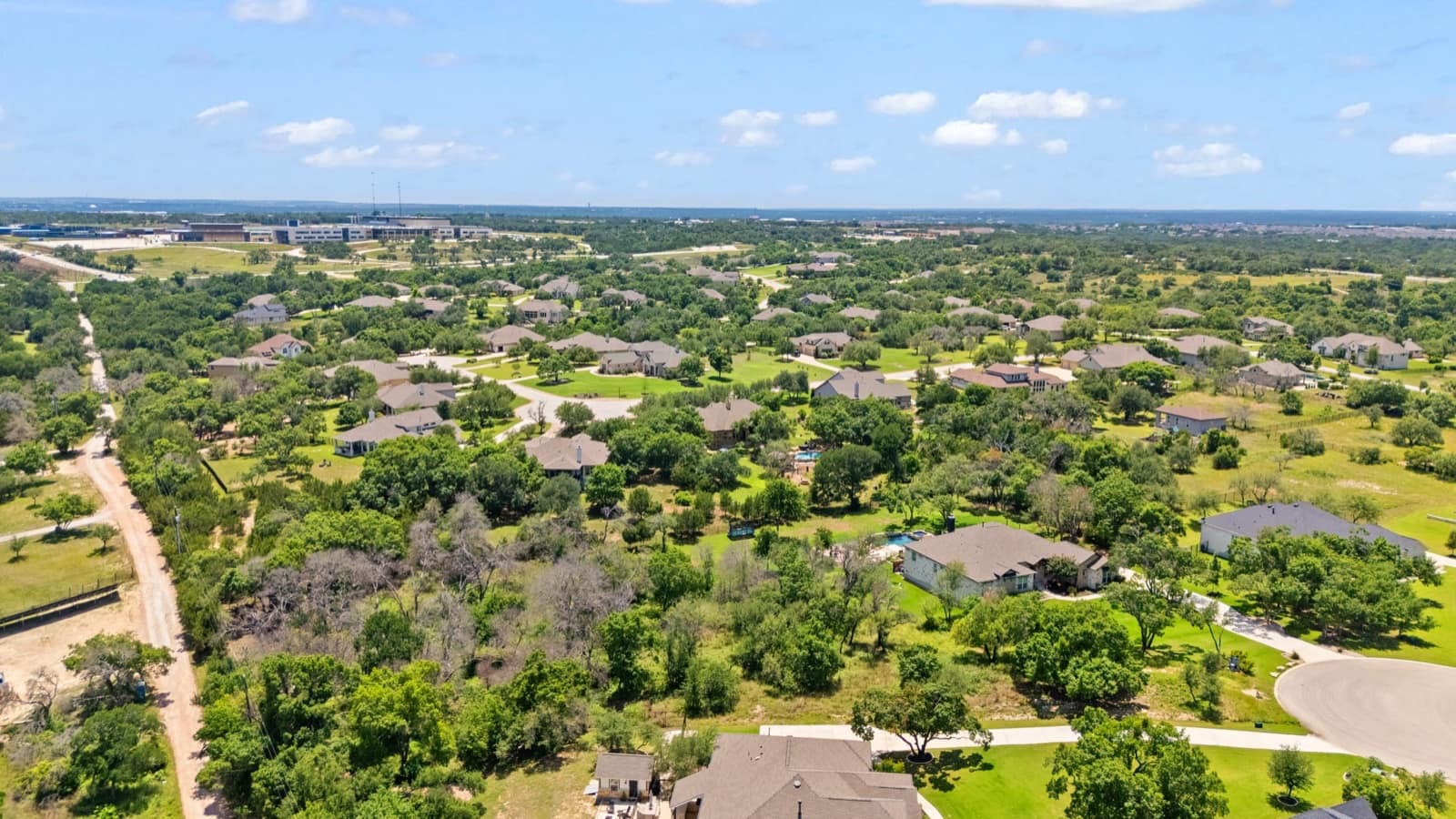
Georgetown keeps topping the growth charts—but a citywide statistic tells you almost nothing about the street you're buying on. Here's how to read the growth story like a local, and how to verify what it means for one specific address.
By the U.S. Census Bureau's count, Georgetown was the fastest-growing city in America (among cities of 50,000 or more) for three straight years, and it has kept adding residents at a pace few cities anywhere can match—from roughly 68,700 people at the 2020 Census to estimates above 115,000 by 2026. Between 2020 and 2025, Georgetown added more new residents in raw numbers than any other city in the country.
Headlines like that make good dinner-party trivia, but they're a blunt instrument for a buyer. Growth doesn't land evenly. One neighborhood gets a new H-E-B and a widened road; another gets three years of construction traffic and a rezoned school. The same force that supports long-term property values can also put a future retail pad behind your back fence.
This guide is about turning the growth story into something you can actually use: where development is concentrated, what's being built to keep up, what the fine print (MUDs, PIDs, school boundaries) means for your monthly payment, and a checklist for verifying all of it before you write an offer.
How Fast Is Georgetown Actually Growing?
The numbers are unusual even by Texas standards. Georgetown's population sat at 68,725 in the 2020 Census; by 2025–2026, city and Census estimates put it well past 110,000, and Williamson County regularly ranks among the fastest-growing counties in the nation. Two practical takeaways for a buyer: this is structural growth—driven by Austin-area employment, in-migration, and available land—not a one-year spike; and the pace means any static description of Georgetown, including this one, ages quickly. The map you tour in spring can look different by fall.
Where the Growth Is Concentrated
Growth in Georgetown has a geography, and knowing it helps you predict what your surroundings will look like in five years.
West along SH 29
The corridor west of I-35 toward Liberty Hill is home to Wolf Ranch and a string of newer master-planned communities, plus the retail that follows rooftops. This is where much of Georgetown's higher-end new construction lives, and where road capacity is under the most visible strain.
North along I-35 and Williams Drive
Sun City, Berry Creek, and newer phases north of town continue to expand, with commercial development filling in along the frontage roads.
East toward SH 130
The east side—along SH 130, Patriot Way, and the corridor toward the regional airport—is a major frontier for both residential development and public infrastructure. Georgetown ISD's newest campuses are being built off Patriot Way near SH 130, a strong signal of where the district expects students to come from.
When you tour a home, ask what's platted—not just what's built—on the open land nearby. The City of Georgetown's planning and development department publishes development maps and case information, and a few minutes there can tell you whether that peaceful field behind a listing is a future neighborhood, a school site, or commercial frontage.
Roads and Infrastructure: What's Being Built to Keep Up
Road projects matter twice: construction is a multi-year daily-life cost, and the finished road can change both convenience and traffic patterns. As of mid-2026, the projects most relevant to Georgetown buyers include:
- I-35 improvements between Georgetown and Round Rock. TxDOT has been advancing plans for a roughly 13-mile stretch of I-35 south to SH 45, including added lanes and reworked interchanges. Major interstate work spans many years—verify current phasing with TxDOT.
- Hero Way / RM 2243 widening. Williamson County broke ground in early 2026 on a multi-phase reconstruction between the 183A tollway in Leander and the Southwest Bypass near Georgetown—a significant east–west link.
- 183A Phase III. The tollway extension from Hero Way toward SH 29 near Liberty Hill improves northwest access, which affects how Georgetown compares with Liberty Hill and Leander for certain commutes.
- SH 29 and US 183 studies. TxDOT has ongoing congestion studies on both corridors. Studies are not construction dates—treat them as direction, not schedule.
The practical question for any single property: which projects touch your daily routes, and will you be living with the disruption phase or the finished phase during your ownership window?
Utilities, Taxes, MUDs, and PIDs: The Fine Print of Fast Growth
Fast-growing cities finance infrastructure in ways that show up on your tax bill, and two properties with identical list prices can carry meaningfully different monthly costs. Most Georgetown addresses pay property taxes to a stack of entities: Williamson County, the City of Georgetown (or another jurisdiction), the school district, and sometimes special districts. Beyond the base stack, many newer communities sit inside a Municipal Utility District (MUD) or are subject to a Public Improvement District (PID) assessment—mechanisms developers use to finance water, sewer, and roads. A MUD adds its own tax rate; a PID adds an assessment that may be paid annually or in a lump sum. Both are disclosed in the transaction, but the time to understand them is before you're under contract, not at closing.
Utilities are their own wrinkle. Georgetown operates its own electric and water utility for much of the city, but the edges of the growth area are served by a patchwork of providers, and water service areas don't always match city limits. Confirm who provides electric, water, and wastewater for the specific address. And remember the standard Texas homeowner math: no state income tax, meaningful property taxes, and a homestead exemption (filed free with the Williamson Central Appraisal District) worth submitting promptly after closing.
Schools: Capacity, Boundaries, and Why You Verify by Address
Growth puts real pressure on school planning, and Georgetown is a live example. Voters approved a large Georgetown ISD bond program in 2024 to fund new campuses; the district broke ground on a new middle school and elementary school off Patriot Way near SH 130, then in early 2026 pushed their openings to the 2027–28 school year as enrollment projections softened. Alongside new campuses, the district has been working through attendance-boundary changes to balance enrollment at crowded schools.
None of that is a reason for alarm—it's the normal machinery of a fast-growing district—but it has a direct implication for buyers: school assignments in a growth market are not permanent. Verify currently assigned campuses by the exact property address with the district—not the listing or the mailing address (a Georgetown address may be zoned to Georgetown, Liberty Hill, or Leander ISD). If a specific campus matters to your family, ask whether boundary studies are underway for that area, and review campus information at the Texas Education Agency's txschools.gov.
What Growth Means If You're Buying
Growth cuts both ways for buyers, and it's worth being honest about each edge.
The favorable side: sustained in-migration supports long-term demand, new construction keeps supply (and therefore price pressure) more reasonable than in landlocked markets, and infrastructure generally improves over time. Builder competition also produces incentives that can meaningfully lower your effective cost.
The harder side: construction disruption can last years; early residents of a new community live through several phases of buildout; nearby open land will not stay open; and builder competition can weigh on the resale value of a lightly used home for as long as new ones are selling nearby. The buyers who fare best treat growth as a variable to underwrite, not a slogan: What is planned around this property? What will my routes look like? What is the total tax rate? Who will I compete with if I need to sell in five years?
What Growth Means If You're Selling
For sellers, growth guarantees demand exists—it does not guarantee your price. Every buyer considering your home is also being courted by builders with incentive budgets, and a growing market means your comparable sales age quickly in both directions. Growth rewards sellers who price against today's competition (including new construction within a reasonable radius), present their home's advantages over a new build—established trees, finished window coverings and landscaping, a known tax rate, no construction traffic—and stay alert to how the current phase of nearby development affects buyer perception.
A Property-Level Verification Checklist
Before writing an offer on any Georgetown-area home, verify the following for the specific address:
- Zoning and platted development on adjacent and nearby parcels (City of Georgetown planning department, or the county for unincorporated areas).
- Road projects touching your daily routes—status, timeline, and final configuration (TxDOT and Williamson County project pages).
- Total property tax rate, entity by entity, including any MUD (Williamson Central Appraisal District tax records).
- PID assessments—whether one exists, the balance, and how it's paid (seller disclosure, title commitment, city PID records).
- Utility providers for electric, water, and wastewater, plus internet options.
- School district and campus assignments, confirmed with the district, plus any pending boundary studies.
- HOA documents—dues, restrictions, and what future phases the developer still controls.
- Floodplain status via FEMA flood maps, especially near the San Gabriel forks and creek corridors.
The Bottom Line
Georgetown's growth is the most important fact about its housing market—and the least useful one in raw form. What matters for you is how growth expresses itself at one address: the platted land next door, the road project on your commute, the tax stack on the bill, and the school assignment that may move. Do the property-level verification, weigh the tradeoffs honestly, and growth becomes something you can plan around rather than guess about. A Georgetown-rooted agent who tracks the development pipeline can shortcut much of this work—but the checklist is yours either way.
Population figures, road-project statuses, tax rates, and school plans cited here are time-sensitive and current only as of mid-2026. Verify each against official sources—the U.S. Census Bureau, TxDOT, Williamson County, the Williamson Central Appraisal District, and the relevant school district—before relying on them for a purchase decision.