The big-picture map to one of America’s fastest-growing counties — its geography, its growth corridors, its towns, its price tiers, and the tax-and-district fine print every buyer should read before signing.
There’s a reason the moving trucks keep pointing north. For two decades, the story of Austin has been a story of growth spilling outward, and no place has caught more of that wave than Williamson County. Cross the line from Travis County heading north and you enter one of the fastest-growing counties in the nation — a patchwork of historic Squares, ranchland turning into rooftops, semiconductor money, and master-planned communities with resort pools. If you’re trying to figure out where to buy north of Austin, this is the macro guide: how the county is built, where the growth is flowing, what the towns are like, what things cost, and how to read the tax fine print before you fall for a floor plan.
The Lay of the Land
Williamson County — locals just say “Wilco” — sits directly north of Travis County and the City of Austin. Georgetown, the county seat, anchors the center; Round Rock, the largest city, sits to its south; and a ring of fast-growing towns fills in around them. The county has been a serial record-setter, with Georgetown named the nation’s fastest-growing city (among those over 50,000) for 2021, 2022, and 2023 by the Census Bureau.
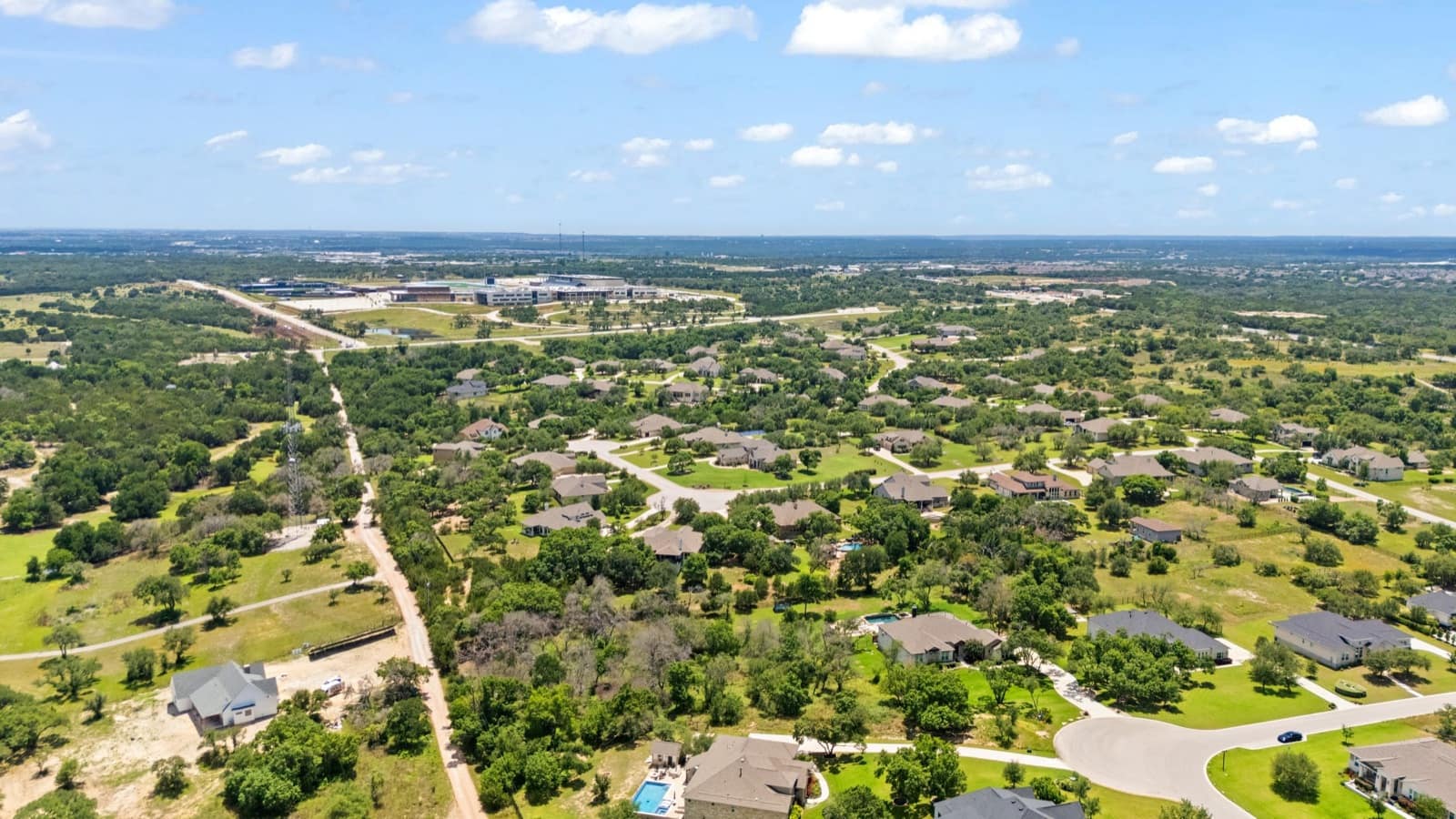
Geographically, the county splits into two characters. The western edge climbs into the Hill Country — rolling, scenic, more land, towns like Liberty Hill and the western reaches of Leander and Georgetown. The eastern and central stretches are flatter, more affordable, and increasingly industrial-adjacent, with Hutto, Taylor, and Jarrell catching the spillover. Understanding which side of that line a community sits on tells you a great deal about its scenery, its lot sizes, and its price.
There’s a deeper geography at work, too. The Balcones Escarpment — the fault line that separates the Hill Country from the coastal plains — runs roughly through the western part of the metro, which is why neighborhoods just a few miles apart can feel like different worlds. West of that line you get limestone, cedar, oak, and elevation; east of it the land flattens, opens, and historically grew cotton and cattle. That same geology shapes everything from water and drainage districts to which lots come with a view and which come with a bigger backyard. Lake Georgetown, the USACE reservoir on the North Fork San Gabriel River, sits right at that scenic western edge and gives the county seat a recreational anchor that the flatter eastern towns can’t match.
The Growth Corridors
Three transportation spines organize almost all the new development:
- The I-35 corridor is the historic backbone: Round Rock, Georgetown, and (further north) Jarrell strung along the interstate. This is the established, job-rich, deep-inventory corridor — and the one that gets congested.
- The 130 / 79 eastern corridor runs toward Hutto and Taylor, where Samsung’s semiconductor plant in Taylor is the single biggest economic catalyst in the region, drawing jobs and housing demand eastward and giving the 130 tollway a fresh strategic importance.
- The 183A toll corridor carries the southwest, threading Leander and connecting to the Capital MetroRail Red Line — the metro’s only commuter-rail option, terminating at Leander Station.
Where you buy along these corridors shapes your commute, your job options, and your appreciation prospects.
Town-by-Town Snapshots
Georgetown — The county seat and the marquee draw: the Most Beautiful Town Square in Texas, Southwestern University, Lake Georgetown, the 9,900-home Sun City Texas for the 55-plus crowd, and the master-planned Wolf Ranch. Median sale prices in the low-to-mid $400,000s. The complete package, at a premium.
Round Rock — The county’s largest city (~128,000), global HQ of Dell Technologies, the “Sports Capital of Texas,” and the value-and-inventory leader, with medians roughly $370,000–$420,000. An established suburb with everything already built.
Leander — Rail-connected, amenity-rich, and home to resort-style communities like Travisso and Crystal Falls. Strong Leander ISD schools. The priciest tier, with area medians around $485,000–$492,000.
Liberty Hill — The Hill Country frontier twelve miles west of Georgetown, growing 300-percent-plus since 2020, with land, acreage, and an “A”-rated Liberty Hill ISD. Median around $356,000. Home to the award-winning Santa Rita Ranch.
Hutto — The eastern growth-corridor bet, mascot the Hutto Hippo, with the new Co-Op District downtown and proximity to the Samsung plant. Medians around $370,000.
Jarrell — The affordability champion fifteen miles north on I-35, with medians near $275,000–$295,000 and the large, attainable Sonterra community. The trade-off is commute and amenities.
A note on the towns just beyond the county’s marquee names: Taylor, on the eastern side, has gone from quiet agricultural town to one of the most-watched addresses in Texas thanks to the Samsung semiconductor investment, and its ripple effects on housing reach Hutto, Round Rock, and even Georgetown. And Sun City Texas in Georgetown — the largest 55-plus active-adult community in the state, with roughly 9,900 homes, three championship golf courses, and acres of amenity space — is practically a town unto itself, drawing retirees from across the country and anchoring a whole segment of the county’s market. The point is that “Williamson County real estate” spans not just price tiers but entire lifestyles, from first-time-buyer starter homes in Jarrell to resort-style retirement in Sun City.
Price Tiers at a Glance
| Tier | Towns | Approx. Median |
|---|---|---|
| Most affordable | Jarrell | ~$275K–$295K |
| Attainable | Liberty Hill, Hutto, Round Rock | ~$356K–$420K |
| Premium | Georgetown | low-to-mid $400Ks |
| Top tier | Leander | ~$485K–$492K |
These are approximate, mid-2026 figures that move month to month — treat them as a starting map, not a quote.
The Fine Print: Taxes, MUDs, and PIDs
Here’s the part out-of-state buyers most often miss. Texas has no state income tax, which means local services lean heavily on property taxes — and bills here run higher than the national average, commonly landing around 1.5%–2.5% of value depending on the districts layered onto a property.
Your total rate is the sum of overlapping entities: the county (Wilco’s adopted rate was about 0.3694 per $100 in 2025), the city (Georgetown’s was about 0.3530 per $100), the school district (usually the biggest single slice), plus any special districts. Two of those special districts deserve real attention:
- A MUD (Municipal Utility District) finances water, sewer, and roads in developing areas through bonds repaid by an additional ad valorem property tax set by the MUD board. Rates are typically higher in a community’s early years and can decline as bonds are paid down. Texas law requires sellers to give buyers a MUD notice before contract.
- A PID (Public Improvement District) funds roads, parks, and amenities through a fixed special assessment over roughly 20–30 years, which ends when paid off (and can often be paid early). Since 2021, sellers must provide a PID notice. See the Williamson County PID overview.
Many master-planned communities also carry an HOA on top of all that. The lesson: a community can have property tax plus a MUD plus a PID plus HOA dues, so always total them for true cost of ownership. File your homestead exemption (free, via WCAD) — and know that homesteaded appraised values are capped at 10% growth per year, with extra exemptions and a school-tax ceiling for those 65 and older.
How to Choose
Start with three questions. What’s your budget ceiling, all-in (price plus taxes plus MUD/PID plus HOA)? Where’s your job, and how do you want to get there — I-35 car commute, the 130 toward Taylor, or the Red Line out of Leander? What do you want your weekends to feel like — a historic Square, a Hill Country trail, a resort pool, or simply the lowest possible mortgage? Your answers will narrow six towns to two or three quickly. From there, verify school lines by address at txschools.gov, drive the commute at rush hour, and read every disclosure.
A practical sequence helps. First, get pre-approved so you know your real all-in ceiling. Second, pick your corridor based on where you’ll commute. Third, shortlist two or three towns within that corridor and tour their flagship communities in person — the difference between a Liberty Hill acreage lot and a Round Rock established-suburb cul-de-sac is something you feel, not something a listing photo conveys. Fourth, pull the full tax-and-district picture on any home you’re serious about, because in Williamson County that fine print is the difference between an affordable payment and a stretched one. And finally, lean on a local agent who can read the disclosures and knows which communities carry the heavy MUD rates and which school lines actually serve which streets.
The Bottom Line
Williamson County isn’t one market — it’s a half-dozen of them, sorted by corridor, scenery, and price tier, all riding the same growth wave north out of Austin. The buyers who do best here treat the search like the layered system it is: pick a corridor, set an all-in budget that includes the tax-and-district fine print, verify the school line, and drive the commute before signing. Get those four things right, and there’s a town up here for nearly every life and budget.
Market figures cited are approximate and current as of mid-2026; verify current data before making real estate decisions.